
How Real is the AI Threat to 3D Animation Studios and Artists?
A new day starts, and before breakfast, machine learning models have already found unthinkable ways to challenge humans in almost everything we do. The new AI era is not the future anymore and companies spend days and nights to maximize potential opportunities.
Major (and minor) corporations are embracing this. Using AI today has become the general norm in all industries and it's helping businesses increase efficiency in data analysis, workflow pipelines and software development. But as a matter of fact, while AI is helping us solve a lot of issues, it is generating a lot more in other ways. Depending on how we use it, we will find different kinds of results, and whoever makes the slightest mistake will find himself left aside and forgotten.
In my week to week life I have the privilege to meet and network with hundreds of people at events, meetings and daily interactions. When they learn what we do at R-25, the first question they do is almost always the same: aren't you scared of AI?
My answer: If I was scared of AI, I would be really bad at business.
Artificial Intelligence (at least in our field) might be something to look at and pay attention to… but at the moment (and in any near future) can't compete with us. Here there is a quick analysis of where we stand right now. Where I think we are going I don't share it yet for obvious reasons…
How AI generated content can be more problematic than helpful?
Artificial Intelligence and machine learning help companies personalize and tailor content to individual users, meaning leaving aside the classic methods of personalization and having the client interact with robots. Even if this sounds counterintuitive, personalization is so generic that every individual will realize the general rules the model is following. We see linkedIn and our email inboxes full of examples like this: as we see more and more content, even if at starters might look personalized, after reading some posts we realize it is all the same. In the beginning we think this is scalable, in the end machine learning has endless capabilities, but then, we realize the engagement drops as time goes by.
In the area of visual and multimedia production, these effects are more exaggerated (if possible). Most gen-AI productions are imperfect, lack personality and precision, display flaws from the top to the bottom and are not even correctly synchronised to their audio.
Because of Gen-AI capabilities in 3D animation, and thanks to the advantages of 3D audiovisual productions, everyday we see more and more AI generated 3D productions. And while they might look decent at a first glimpse, the results they bring are questionable at least. Let´s dig into it from a couple different perspectives:
Why do companies use 3D Animated content to increase ROI?
Thanks to 3D modeling and animation we can show how a product works and not just how it looks, reducing confusion and increasing buyer's confidence. This will shorten the decision making process and increase ROI with product explainers and interactive demos or walkthroughs (like in real estate or yachting). Artificial Intelligence is extremely limited and full of flaws in this sense. As we wouldn´t trust GPT with building us a house, our client wouldn't trust a model of a machine or a boat generated in GPT (or any other AI model).
3D animation helps us reduce costs over time as the assets are reusable and easily updated. With one 3D asset we can power:
Animated ads
Website content
Sales decks
VR experiences
Training videos
This has an obvious impact on ROI as the cost per asset across campaigns is much lower. AI has no power to reuse assets and every time we try to do so, it introduces minor flaws to the asset we are trying to reutilize.
How does AI generated 3D content compare with studio generated 3D content?
So here is the whole point. From technical advantages to emotional impact, 3D generated audiovisual content adds value in every step of the production and delivery chain. Directors know that, customers know that, it seems everyone knows that… Here is when in the so-called AI era (AI bubble if you want), a lot of start ups have found a niche for developing a new model that will generate audiovisual content and (try to) compete with animation studios, but will it?
Let´s make a quick comparison of the outputs of a studio and AI when asked for the same production and then judge yourself the facts:
Strategic Storytelling vs. Asset Generation:
AI makes 3D according to a prompt… Studios design visual narratives aligned with business goals. A studio starts with a strategy, designs a storyboard based on different objectives, and is strategically designed to generate emotions, educate, convert or persuade. AI lacks all of this and is designed to produce isolated assets and scenes without a clear narrative or continuity. This often feels generic.
Accuracy:
This one is simple… while studios follow brand guidelines precisely, maintain consistent lighting, proportions and language and ensure the products look exactly right across all touchpoints, AI will be inconsistent at outputs across generations and will be satisfied with “close enough” geometry or materials and can hallucinate details or distort products. Especially in the Real Estate, Automotive, Maritime or Machinery industries, the minimum inaccuracy is unacceptable.
Production Quality:
Even if over time this might be solved, AI struggles a lot with the fundamentals of 3D production such as correct topology, physically accurate lighting, clean animation curves, good timing and realistic physics. AI outputs still have broken meshes, texture stretching, unnatural motions and impossible lighting.
Even if at a first glimpse it looks acceptable, viewers subconsciously notice bad physics, even if they can't explain why.
And if all this is not enough let's have a look at some data: here we see how AI generated content compares to studio production in a basic marketing campaign:
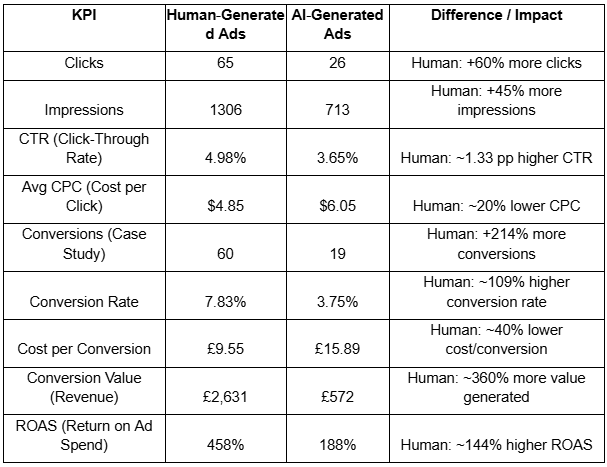
Bottom line, for high-stakes use such as marketing, sales, training, or brand building; studio-produced 3D animation is better because it is intentional, reliable, safe, and strategically aligned with business goals. Companies that rely primarily on AI-generated content will increasingly lose competitive ground to companies that rely on professional 3D animation studios. The loss will not only be aesthetic; it shows up in brand equity, conversion performance, and long-term ROI.
So; if you are a studio, be prepared. If you are an artist, don't worry. And if you are a company… contact me and let R-25´s team take care of your visuals. We are much better than AI.
